I’m Back!

It’s been a while since I’ve written anything. I’ve always had the intention of keeping up a regular blog but for various reasons, mostly working, I never managed to do it. Now I have the time and desire to reach out and express myself.

Two big life changes occurred for me. First, I moved from Belen, NM to Albuquerque, NM where I bought a small house. Second, I retired from the Whitfield Wildlife Conservation Area as of May 29, 2020. After being sequestered and working from home for two months due to Covid19, the transition to retirement didn’t seem that big of a deal. I find myself busier than ever. I don’t know where the time goes as cliched as that sounds.

We have a great little garden going this year. We are already harvesting radishes, Swiss chard, lettuce, and squash.  

Lots of Veggies

Our four chickens have grown up since we got them on Valentine’s Day. Hopefully, we will be getting eggs sometime this summer.

An Americana Chicken and a Black Australorpe Chicken

I completed laying out and mulching my “tropical bed.” I hope to plant winter hardy subtropicals and plants that have a tropical look. I figure since I can’t live in the tropics, I’ll have my own little tropical world right here. 

The Bark-mulched Bed Ready for Planting (June, 2020)

I feed the birds and have been especially pleased with the niger seed-filled socks that I hung up for the finches. Lots of Lesser Goldfinches have been showing up. In the last few days, a Ladder-backed Woodpecker has been coming and eating out of the hummingbird feeder as well as a feeder with a seed block made to attract woodpeckers (obviously works!). 

Ladder-backed Woodpecker at a Hummingbird Feeder
Ladder-backed Woodpecker at a Bird Feeder

Since I lasted posted, I went on two trips that I will be writing about in upcoming blogs. In August 2019, I traveled to Vietnam, a country full of surprises. In January, I took a winter vacation to Puerto Vallarta, México, where one of the highlights among others was a whale watching trip. I’m looking forward to the day when travel is safe again and the Corona Virus is a memory.

I’m looking forward to sharing my life’s journey with you with things that may interest and inspire you in the future. 

June’s PlantAsia

I haven’t posted recently as I was in Vietnam and then moved into a new house. More on both of those in later posts. In the meantime here are some pictures from this past summer’s trip to the Denver Botanic Gardens.


The Denver Botanic Gardens is a wonderful place with lots of colorful perennial borders and showy flower displays, but there is one garden there that isn’t as much about flowers as it is about foliage and structure. It is a beautiful composition in green.

That garden is June’s PlantAsia. I’m not sure about the name as to who June is but PlantAsia refers to the plants from our largest continent. The structures in the garden such as the moon gates are primarily Chinese in design. 

Here is an Asian, my friend Huy, in a moon gate in the Asian garden.

I love the composition of the large leafed plant with the rock lined stream bed. I’m not sure what the plant is although I think it may be Petasites japonicus, commonly called butterbur or coltsfoot. I’d love to have it in my garden, but it takes way too much water in the arid climate of New Mexico.

I loved the walkways which consist of irregularly shaped stones with flowing “rivers” of black pebbles cemented in between. Don’t you just want to follow it to see where it leads to?

I liked the small signs with quotes in the garden.

This statue is nicely framed by a moon gate.

An Asian garden would be incomplete without Buddha appearing in it somewhere.

This only a small glimpse of one garden out of many that comprise the Denver Botanic Gardens, which is one of the best in the world. Be sure to visit it next time you are in Denver.

The Gorgeous Getty Gardens

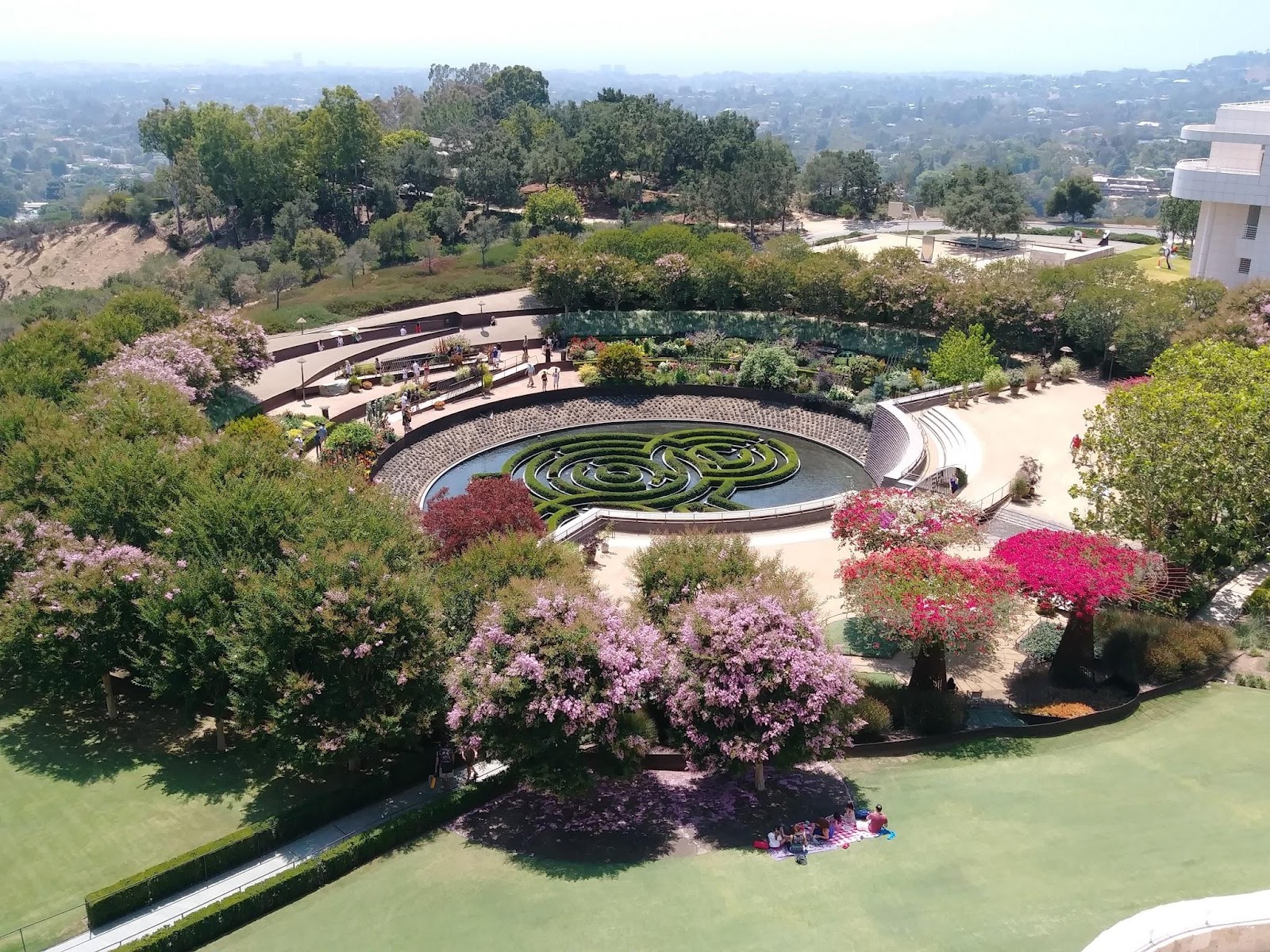
I have a love of art and gardens and one of my favorite places, the Getty Center in Los Angeles, has both. While known for its outstanding art collection, the gardens are an artistic masterpiece in themselves that change all the time as one plant blooms while another fades away. Designed by California artist Robert Irwin, the Central Garden is one of the two showpiece gardens, the other being the Cactus Garden, at the Getty.

It was a hot, sunny summer day the day I visited and the air was hazy. I went on one of the regularly scheduled tours you can take with a docent. It was a good introduction to the Getty and it’s grounds and gardens and I highly recommend doing so when you visit. 

The Central Garden is so named as it is the heart of the Getty Center campus. Your journey begins along a man-made stream, heavily planted with all kinds of plants including lots of succulents, flowers, shrubs and trees. Over 500 kinds of plants are planted in the garden. 

At the heart of the garden lies a maze of azaleas (long past bloom when I was there) set in a large pool of water with a waterfall. This highly ordered design element is surrounded by a colorful cast of flowers in all colors. A variety of plant textures contributes to the overall composition.

Large, sculptural trees are covered with bright red bougainvillea blooms. These are one of the most interesting looking structures in the garden.

Bright red dahlias steal the scene here. The colors and textures of the garden provide a soft contrast to the sharp outlines of the angular, buff white buildings designed by architect, Richard Meier.

Be sure to take advantage of the umbrellas that they offer at the beginning of the tour. While there are shady spots throughout the campus, there are also areas open to the hot California sun. Wear sunscreen of course as well.

Being a cactus lover, I had to go see the cactus garden. It is located in the southeast corner of the Getty complex and actually requires seeking it out. It is totally worth it though as the view over the cacti and the panorama of Los Angeles is stunning. Comprised of columnar cacti (I’m not sure of the species) and more golden barrel cactus (Echinocactus grusonii) than there are probably found in the wild, it is a living sculpture garden, appropriate at an art museum.

While I came for the gardens, there is of course the outstanding collection of art at the Getty. Here are two of the more well-known Impressionist works, Iris by Vincent van Gogh and Wheatstacks, Snow Effect, Morning by Claude Monet.

Irisis, Vincent van Gogh

Wheatstacks, Snow Effect, Morning by Claude Monet

Be sure to plan plenty of time at the Getty Center, perhaps a whole day. The Getty Center sits on a hilltop in the Santa Monica Mountains.  From the moment you begin by taking the tram up the hill from the parking level, you are going to be in brain overload by the time you leave as there is so much to see and take in. The Getty is a must see if you are in Los Angeles.

Chitzen Itza – One of the New7Wonders of the World

Of the Seven Wonders of the Ancient World, only one still exists today, the Great Pyramid of Giza. In 2001, the New7Wonders of the World were chosen from a selection of 200 existing monuments through an online vote. One of those wonders is Chitzen Itza in the Yucatan of Mexico. If you are staying in Cancun or Playa del Carmen along the Mexican Riviera, Chitzen Itza is a must-do trip and easy to do with multiple tour companies available. 

El Castillo

The largest and most famous structure is the pyramid known by the name the Spanish gave it, El Castillo. Not only is it impressive to behold, but its symbology is amazing. At the base of one of the stairs are two large serpent heads. They represent the god Kukulkan, the plumed serpent god worshipped by the Mayans of the Yucatan Peninsula. “During the spring and fall equinoxes, the shadow cast by the angle of the sun and edges of the nine steps of the pyramid combined with the northern stairway and the stone serpent head carvings create the illusion of a massive serpent descending the pyramid.” (Wikipedia)

Kukulkan descending the pyramid (Wikipedia)

Human sacrifice was part of the Mayan religious practices. As in many Mayan cities, the ball court was one of the ritual ceremonies in which someone would end up as a sacrifice to the gods. The ball court at Chitzen Itza is perhaps the largest of the Mayan ball courts. These games were played out before the upper class. 

The ball court at Chitzen Itza

I was surprised to learn that the captain of the winning team would willingly offer himself up for sacrifice. It was believed to be an honor and bring good fortune from the gods to the whole community. On a wall in the ball court is a frieze depicting such a “winner” with blood gushing out of his neck from a severed head. At least this is the story our guide told us. 

Look right of center and the blood is spewing out of his neck


Skull depictions of the sacrificed

On the way to the ball court, there is a low wall that has many skulls around it. Each one is different and was a person who was willing to sacrifice themselves for the greater good of the Itza community during times of drought, for example, to bring rain from the gods. Again, this is the story our guide told us. 

We were lucky to have a great tour guide. I highly recommend Amstar DMC México tour company. I booked both this tour and one to the ruins of Tulum through them and they were excellent in every way. Be aware, that Chitzen Itza is very crowded with tourists (2,000,000 a year) and there are over two thousand vendors(!) you have to walk past coming and going from the ruins. They will try to scam you with lines like, “only one dollar, almost a dollar, almost free, and so on.” Just say no and/or walk on by unless you see something you want to buy. There really are some cool souvenirs there. Also, be sure to wear sunscreen and a hat as it is very open, sunny, and hot there. 

There is much more to see and learn about at Chitzen Itza. You will find Chitzen Itza a fascinating legacy of the ancient Mayan people.

Kukulkan(?), the Plumed Serpent

The Snow White Desert of New Mexico

Sometimes you don’t have to travel far from home to find an exotic destination. Here in New México, there is one place that is so unique that it has been featured in many movies as another planet, filled in for other deserts, and just appeared as itself. That place is White Sands National Monument, which is like no other place on Earth.

Located in the Tularosa Basin of southern New México, White Sands is famous for its pure white sand dunes. I was there with a friend over the Memorial Day weekend. That’s me walking on one of the very large dunes. I hadn’t been here in over 20 years and it was just as fun the second time around. Even with lots of people that day, you can find plenty of space to be alone if you wanted.

Feeling the squishy sand between your toes at White Sands brings the kid out in everybody. Adults and children alike like to play in the dunes. It’s like being at the beach, but without any ocean.

In places, it looks like it snowed with drifts flowing onto the roads. It is actually grains of gypsum forming the largest gypsum dune fields on the planet covering 275 square miles in the Chihuahuan Desert.

While the dunes might seem barren to us humans, there are over 800 animal species found here! Plants grow and thrive here, adapting to the conditions of constantly shifting dunes by growing taller as the dunes fill in around them. Sometimes, the sand then moves away leaving the plants to survive on a pedestal of sand. Nature can be amazing in the way life manages to survive in harsh conditions.

If you go to White Sands, and I strongly urge you to do so, be well prepared. In the last four years, four people have died in the desert conditions. Be sure to wear a hat and sunglasses, put on sunscreen, and bring plenty of water. If traveling alone, be sure to let someone know you will be going there.

The dune field is so large that it can be seen from space, but you can go and it up close and personal. For more information, go to the National Park Service website for White Sands National Monument at https://www.nps.gov/whsa/index.htm.

Mini “Dinosaurs” of the Yucatan

If you are staying along the coast of the Yucatan in the Mexican Riviera Maya or Belize, you are likely to encounter a large lizard that looks like it could be an escapee from Jurassic Park. While not really dinosaurs of course, I first encountered the black spiny-tailed iguana, Ctenosaura similis, several years ago on Caye Caulker, an island off the coast of Belize.

A Black Spiny-tailed Iguana at Sandos Caracol Eco-Resort

I’m not sure why they are described as black when they are really a gray similar to the limestone rocks they seem to prefer living on. I read it is the black banding on the tail, but again, it doesn’t seem all that prominent. That is the common name; however, and they do have spiny tails.

I saw them again recently in Playa del Carmen at the Sandos Caracol Eco Resort and at the Mayan Ruins of Tulum, where it seemed that every rock and ruin had its own personal iguana. This isn’t surprising as they prefer rocky habitat as well as trees to climb. I’ve seen them both on rocks as mentioned and also lounging on tree branches.

On ruins at Tulum
Also at Tulum

These fierce-looking reptiles are relatively harmless if you leave them alone. They will bite and lash their tales if cornered, as do many in the iguana family. Another defensive strategy is to run away from predators. According to the Guinness Book of World Records, they are the fastest lizard in the world having been clocked at an amazing speed of 21.5 mph.

Black spiny-tailed iguanas are primarily vegetarians that feed on flowers, fruit, and leaves but will also eat insects, small animals, and eggs when they find them. They are perhaps the only animal that can eat the extremely toxic fruit of the manchineel tree, listed as the most poisonous tree in the world by the Guinness Book of World Records. One fruit is said to be enough to kill 20 people and even the sap is toxic to touch.

The males are larger growing just over 4ft in length compared to just over 3ft for the females. The males will defend a small territory against other males, so when you see two together it is usually a male and female as they will tolerate a female in their space.

Most likely a male (larger one) and female (smaller one)

Black spiny-tailed iguanas have a large range throughout Central America down into the northwestern corner of Columbia in South America. They have been introduced into Florida where they are considered an invasive species and a threat to native plants and animals.

By rbrausse, CC BY-SA 3.0, https://commons.wikimedia.org/w/index.php?curid=25102569

As with their distant cousins, the green iguana, black-spiny tailed iguanas sometimes wind up on the dinner table in Central America where they are known as “chicken of the trees.” I would rather just watch these fascinating lizards that seem to hark back to an earlier reptilian age.

Living in the small Mayan ruins on the grounds of Sandos Caracol Eco-Resort

Furry Critters at Sandos Caracol Eco Resort

I recently stayed at the Sandos Caracol Eco-Resort near Playa del Carmen. As its name suggests, this is a place to enjoy nature, granted within an all-inclusive, large resort setting. I wanted to see some wildlife and I wasn’t disappointed.

One of the first animals I encountered was the very cute and somewhat comical coatimundis (coatis for short). Native to the Americas from the southwestern United States (we have them in my home state of New Mexico) through northern Uruguay, these members of the raccoon family seemed to be everywhere on the resort grounds. They were out scavenging food from trash cans and from that dropped by the resort guests. They didn’t seem to be aggressive, which isn’t surprising since they are in constant contact with people all around them.

A Coatimundi at Sandos
Coatis rooting for insects

When the day shift ended for the coati’s, their cousins, the raccoons, would come out on the night shift and look for leftovers from the day’s activities. Trash cans seemed to be no obstacle. Unlike the coatis, they were much more wary of people although they were still out and about. As such, I wasn’t able to get any good pictures of the little masked rascals.

A night stalker at Sandos who had just raided a garbage can
Cute banditos

If you visit Sandos, remember that although these animals are very comfortable around people, they are still wild. Don’t feed them or try to touch them as they may bite. Just enjoy their antics as they wander around the grounds of the resort. Next, I’ll introduce you to an animal at Sandos that looks like it could be straight out of Jurassic Park (although much smaller)

Welcome to Ted’s Universe

Looking out over Sarangani Bay in Mindanao in the Philippines

A little about myself and the subjects of my blog:

I’m Ted Hodoba. My last name is the source of a lot of of confusion for people trying to figure out how to say it and/or spell it. I must admit it is unusual and is Slavic, most likely Ukrainian (Carpathian Rusyn) in origin. I grew up in north central Pennsylvania but moved to New México when I was 27 and have been here ever since.

New México is a unique place, perhaps the most Latin American state with direct cultural ties to the south, that is México and Central America. It also has one of the longest histories of continued habitation by indigenous peoples in the Americas. I will be writing more about myself and New México in future blogs for sure.

Abo Ruins in New Mexico

I have many interests and passions in life, but three will be the primary foci of this blog: Art, Travel, and Nature. I hope you will continue with me on my blogging journey.